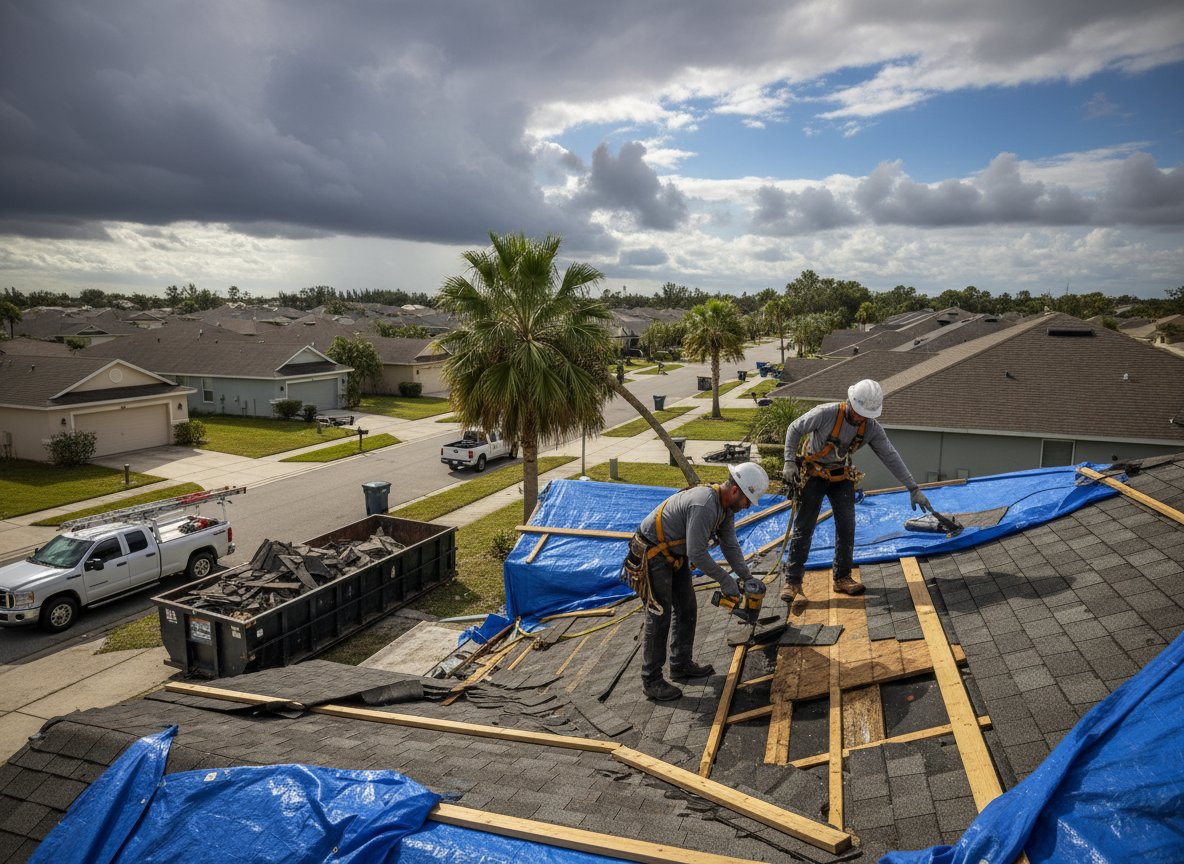
Crestview is the county seat and the largest city in Okaloosa County, and it is a different place from the beach towns forty minutes south. It sits inland on high ground — roughly 236 feet above sea level, which puts it among the highest points in Florida — at the crossing of the old highway corridor and the north-south route that runs down to the coast. The city grew around a crossroads and a railway, then filled out with subdivisions as the military and civilian workforce spread north. Roof repair in Crestview, FL is not a beachfront problem. There is no salt spray and no storm surge. What there is, instead, is wind arriving with nothing to slow it down, a hot inland summer, and two very different roof stocks sharing one set of streets.
The elevation is more than trivia. High ground means the city drains, which is good for foundations and good for roofs, because water does not sit against a wall for days after a storm. It also means the city is exposed. A ridge of high ground with fewer trees than the coast and no bay to break the wind is a place where a gust arrives at full strength, and roofs here take uplift on the edges in a way that sheltered coastal streets do not.
Two Roof Markets on One Set of Streets
The older Crestview stock sits close to the centre: 1920s to 1970s houses on modest lots, with hipped and gabled roofs, board decking, and a history of re-covering that often includes at least one layer added rather than removed. There is a commercial core around the courthouse and the main corridors where low-slope roofs cover shops, offices and sheds, and a good deal of it has been recoated rather than replaced.
The newer stock is the subdivisions that spread out from the 1990s onward — truss-framed houses under asphalt shingle, with long unbroken planes, attached garages and a rear lanai or porch whose roof is shallower than the main roof. On the rural edges of the city, and on the large lots outside it, metal is common: barns, workshops, sheds and some houses under exposed-fastener or concealed-fix panel.
The two markets need different work. On the older houses the question is the deck and how many layers are above it. On the newer houses the question is whether the original shingle has reached the end of its life and whether the fastening meets the wind design for the site. On the rural buildings it is usually fasteners and corrosion at the cut edges rather than the covering itself.
Inland Weather, and Why It Is Not Gentler
People assume that moving inland reduces weather risk. It reduces water risk and increases wind exposure, and it adds two things the coast does not see as often: lightning and hail. Crestview sits in a part of the state where summer thunderstorms are frequent and often severe, and a strike on a roof can start a fire inside the attic or leave a pinhole that leaks for months before anyone notices. Hail in this region is usually small, but a storm that drops it hard enough will bruise a shingle mat, and bruised shingle fails early.
Then there is the heat. An inland roof in July sits under a sun that has not been filtered by coastal cloud and on a deck that is being heated from both sides. Attic temperatures climb, and the shingle on the south and west planes ages faster than the rest. A roof that looks uniform from the street can be five years further along on one slope, and that is why the survey photographs each plane separately.
Where Crestview Roofs Fail First
Set storms aside and the local failures are consistent. The valley is first: two planes meet and the volume of water doubles, and on an older house a valley lined with a single layer of underlayment and a rolled edge is usually the first thing to go. The wall junction is second, whether the wall is brick, stucco or siding, because water that gets behind cladding travels sideways and shows up well away from the entry point.
The pipe boot is third. The rubber collar around a plumbing vent perishes in Florida sun long before the shingles around it wear out, and a split boot is a small repair that becomes a deck repair if it is left for two seasons. The fourth is the low-slope addition — the porch, the lanai, the shed, the shop roof — where water stands rather than runs and the seams take the strain.
On the newer subdivisions there is a fifth, less obvious issue: the ridge vent. A ridge vent that has been blocked by insulation, or one that was installed over too short a run for the attic it serves, turns the attic into an oven and ages the upper slopes early. It is one of the simplest things to correct and one of the most commonly missed.
Storms That Reached This Far Inland
Crestview is far enough from the Gulf that a landfall does not arrive here as a surge event, but it is close enough that the wind does. Hurricane Ivan came inland across this part of the Panhandle in September 2004 and drove wind and rain through Okaloosa County well north of the beach. Hurricane Dennis passed through the same region in July 2005. Hurricane Michael in October 2018 made landfall at Mexico Beach and tracked north-northeast inland, and although its centre passed east of Crestview, the county still took wind and rain from a very large circulation. Hurricane Sally in September 2020 moved slowly across the western Panhandle and produced a long period of wind and rain rather than a short burst.
The damage pattern inland is different from the coast. Trees come down, and a tree that comes down on a roof does not care what the covering is. Ridge vents and ridge caps fail, because that is where the roof presents an edge at its highest point. Gutters and soffits are pulled, and shingle is lost at the rakes and hips. Water then enters at the broken point and travels, and the interior damage appears in a room that is not under the hole.
Picking the Right Job in Crestview
The site's service list is the full range; on a Crestview property the survey picks from it quickly. A ceiling stain after rain is a leak, and roof leak repair finds the entry rather than repainting the symptom. A roof opened by a falling tree or a gust is emergency roof tarping first, then emergency roof repair where the opening can be closed in one visit, then storm and hurricane damage repair where the whole roof has to be documented and rebuilt — a job that is half building work and half record-keeping.
Underneath that, the deck decides. Roof repair is enough while the sheathing is sound and the covering has life. Roof replacement is honest where timber is soft in more than one place and the underlayment has gone. Roof installation covers a building that never had a covering. Shingle roofing is the default for the town and the subdivisions; metal roofing is the natural choice for outbuildings, workshops and rural houses; tile roofing suits particular elevations; flat roof repair and roof coating deal with the shallow sections; and roof inspection is what makes the choice defensible.
Outbuildings and the Rural Half of the Job
A significant part of the roofing work around Crestview is not on houses. Workshops, barns, equipment sheds, pole buildings and detached garages on the lots inside the city and on the land around it carry metal roofs that are older than the buildings look, and they are frequently the structure an owner actually needs fixed. A shed roof that has started to leak is not usually an aesthetic problem; it is a problem for whatever is stored underneath.
The failure pattern on these buildings is consistent. An exposed-fastener panel roof loses its washers first, and the leak appears at a fastening line that runs the length of the roof rather than at one point. The purlins beneath corrode where water has been sitting, and the sheet itself may be sound for years after the fastening has failed. That is a repair rather than a replacement, and it is worth doing properly because a shed roof left leaking will rot the structure from the top down.
On a house with a detached garage or a covered workshop, the survey covers both buildings, and the scope separates them. It is common for the house to need a small repair and the outbuilding to need a new roof, or the reverse. Keeping the two documented separately is also useful when the work is planned in stages, which on a rural property it often is.
The Corridor and Its Commercial Roofs
Crestview is a crossroads town, and the highway corridors that made it one are lined with low commercial buildings: shops, offices, storage units, workshops and sheds. Almost all of them are low-slope, and almost all of them have been maintained by recoating rather than by replacement. That is a reasonable strategy while the assembly underneath stays dry, and a poor one once water has been getting in.
The failure points on these roofs are not the ones a homeowner would recognise. A drain that sits slightly high leaves water standing, and standing water works at every seam. A parapet wall holds water against the edge, and the termination there is where the wind and the water both arrive. A penetration added for a new unit — an extractor, a flue, a conduit — is often flashed with sealant rather than with metal, and it is the first thing to fail.
A commercial survey therefore maps the drains and the slopes before it looks at the surface, and it records what the coating is covering. Where the deck and insulation are sound, a coating or a membrane overlay is a legitimate answer. Where they are not, no coating will hold, and the honest scope says so.
Running a Crestview Job
The roof is looked at before anything is promised. That means walking it where it is safe, entering the attic where there is access, photographing each slope and junction, and reading the sheathing from below. On a property with outbuildings the survey covers them too, because a workshop roof is often in worse shape than the house.
Next is a written scope: what is stripped, what is repaired, what is excluded, which products are named, and what the work assumes about the deck. Permission is applied for from that scope, with the covering's approval and fastening schedule attached, and the job then follows the inspection order the city or county sets. The finish is a signed inspection, photographs of everything that was covered up, and a walk of the property with the owner.
The Permit Office and the Wind Rules
Crestview issues permits within the city limits; Okaloosa County issues them on unincorporated land, which around here is a large share of the map. Separate systems, separate queues, and the address resolved before scheduling. The High-Velocity Hurricane Zone ends far south of here, at Miami-Dade and Broward, but the statewide wind provisions still set the design wind speed and the fastening schedule, and the covering still needs a current product approval. On a metal building the fastening and the corrosion resistance of the fasteners matter as much as the sheet itself. Contract work opens with a notice of commencement.
Around Crestview
Milligan lies southwest, Auburn and Deerland to the west, Holt toward the east and Baker to the northeast, with unincorporated communities strung along the old highway between them. Housing and outbuildings differ from one to the next, and each address is matched to its permit office before a date is set.
How to Start
Call with the address, because it decides who permits the work. Add the roof's age if it is known, and mention any outbuilding at the start, since it changes the scope. A photograph from the ground and a note of where water shows inside help before the first visit. Florida Roof Repair Pros is at 4720 Millenia Blvd, Suite 175, Orlando, FL 32839, on (407) 557-4529.
Around Crestview
We regularly work near:
- 📍Okaloosa County Courthouse
- 📍Twin Hills Park
- 📍Yellow River
- 📍Blackwater River State Forest, north of the city
- 📍Eglin Air Force Base reservation
Roof Repair in Crestview — Local Notes
- •County seat of Okaloosa County, about 236 feet above sea level
- •Inland: wind and trees rather than surge
- •Rural metal buildings are a large part of the work