Coral Springs is the one city in this batch where salt is not part of the story. It was drawn rather than grown — incorporated in 1963 as a planned community on open ground well west of the coastal ridge — and built out over four decades to a master plan, neighbourhood by neighbourhood. That single fact explains most of what a roofer finds here: housing younger than almost anywhere else in Broward, streets and lots laid out together, asphalt shingle on nearly every roof, and deed restrictions that have an opinion about what a replacement may look like. Roof repair in Coral Springs, FL is a question of timing and paperwork more than survival.
The city sits in Broward County and therefore inside the High-Velocity Hurricane Zone, so the assemblies are specified even though the ocean is a dozen miles east. What replaces the salt load of a beach town is heat: an inland roof runs hotter, an attic here bakes for more of the year, and shingle ages on a schedule set by ventilation as much as by sun. Florida Roof Repair Pros covers Coral Springs from an office in Orlando, and the number for this city is (407) 557-4529.
Built to a Plan, Which Makes Roofs Predictable
A master plan produces uniformity, and uniformity is a gift when judging a roof. Inside a village or subdivision the houses went up within a few years of each other, often by the same builders, from a handful of models. The roof structures repeat, the pitches repeat, the ventilation details repeat, and so do the failures. When one house on a street reaches the end of its shingle, the neighbours are usually a season or two behind, and a survey of one property says something useful about the rest.
It also means very little here is genuinely old. Coral Springs has almost none of the 1920s barrel tile or the 1950s flat-roof apartment stock that shapes the coastal cities, and almost none of the mid-century flat sections that complicate a Pompano Beach or Hollywood roof. What it has instead is a large volume of pitched shingle on truss framing over concrete block, with tile on a minority of later and larger houses, and a small amount of low-slope work over commercial buildings along the main roads.
Heat, Not Salt
An inland Broward roof is spared the corrosion that eats fixings near the Intracoastal, and it pays for that in temperature. Without the coastal breeze the deck runs hotter through the afternoon, and a shingle roof with restricted ventilation runs hotter still. The visible result is granule loss on the south and west planes well before the rest of the field looks tired, and a mat that turns brittle years ahead of its nominal service life.
Attic ventilation is where an inland roof earns or loses its years, and in a planned city it is unusually easy to inspect. The houses were built to a small number of designs, so the intake and exhaust pattern on one street is usually the pattern on the next. Soffit vents at the eave feed a ridge or off-ridge vent at the top, and the circuit only moves air while both ends stay clear. Insulation packed against the deck, a soffit repainted without clearing its perforations, or a screen matted with dust all shut the intake. Once that happens the exhaust pulls from wherever it can, the deck stays hot, and the shingle cures from underneath.
Heat is not the only way a closed attic shows itself. Sheathing that stays damp, fasteners rusting from the inside, and a brown line along the ridge that fades in dry weather all point to the same restricted airflow rather than an active leak. Telling the two apart matters, because a moisture problem answered with sealant returns every wet season.
Shingle Life in an Orderly City
Because the stock was built in sequence, the replacement wave moves through the city in sequence. The earliest villages are now on their second or third roof; the 1990s phases are reaching the end of their first; the 2000s phases are into repair territory rather than replacement. A homeowner on a street where every house was built in the same year can usually read the future from the neighbour's driveway, though the neighbour's roof may have been replaced earlier for reasons that do not apply next door.
What decides the next step is not appearance but the deck. A shingle roof at twenty years can still look presentable while the underlayment beneath it has baked out, and the only way to know is to open the roof at a valley, a ridge and a penetration and read what is underneath. Where an earlier owner added a second layer, the roof has been running hotter for years and the schedule has shortened accordingly.
Whether a second layer can go over the first is settled by the sheathing, not by the calendar. Broward's code allows a re-cover in some cases, and the allowance depends on how many layers already exist and on what the deck looks like once it is opened at a test area. Coral Springs has enough roofs now at the end of their first term that the question arrives most weeks. The answer usually starts with opening the roof at a valley and a penetration before anything is proposed.
Deed Restrictions and the HOA
Coral Springs has an unusual amount of private governance for a Florida city, and on a roof replacement it matters. Deed restrictions and association rules can govern the material, the profile and the colour of a replacement roof, and some require approval before work begins. A proposal that satisfies the building code and the hurricane zone can still be refused by an architectural review committee because the shingle is the wrong shade.
The practical sequence is therefore approval before order. Establish what the association requires, get the approval in writing where the association issues one, and only then order material. On a tile roof the same principle applies to profile and colour, and on a house in a village with a consistent look it is worth checking what the neighbours actually installed rather than what the brochure shows.
Where the Leaks Actually Are
The places water gets in on a Coral Springs roof are predictable because the houses repeat. Collars around plumbing stacks and vents come first, since the neoprene boot that seals them hardens and splits long before the shingle around it wears. Hip and ridge caps are second, cracking where they bend over the peak. Valleys collect everything the two planes above them shed, and a shallow pitch gives that water less time to leave. The fourth is wherever a pitched roof meets a low-slope porch or addition, a junction that needs two different systems to agree.
Storm damage on these roofs follows the wind, and the wind finds edges. Eaves, rakes and the ridge line take the first lift, and a single opened corner lets pressure build beneath the field until whole courses release instead of single tabs. That is why a post-storm inspection starts at the perimeter and works inward: the pattern of what failed at the edge explains what happened across the rest.
A stain on a ceiling is a destination, not an origin. Water entering at a stack boot or in a valley can travel along the underside of the deck, follow a truss chord and surface in a room nowhere near the opening. Sealing the mark without tracing it back leaves the actual entry untouched, and the next driving rain from the east will find the same path.
What Gets Done, and in What Order
Most calls here are leak repair, and the work is diagnostic: the attic, the penetrations, the flashings, then the repair itself. Inspection is the other common request, usually attached to a sale, a purchase or an insurer's question, and on a roof of this age it is what separates a repair from a replacement decision.
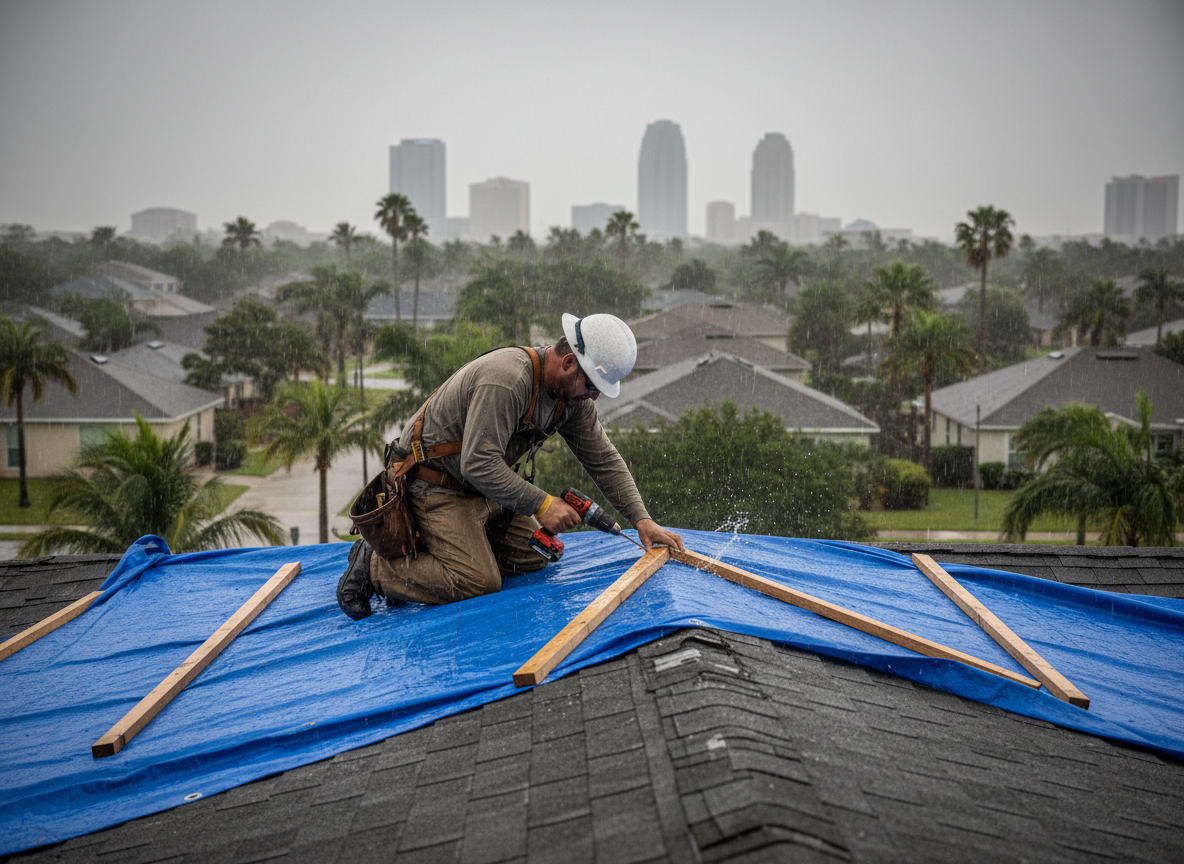
Emergency work covers what cannot wait, such as a limb through the deck, a lifted edge after a squall, or a collar that split overnight. Storm and hurricane damage repair is the larger job that follows, and it is documented from the first visit because an adjuster will later need to separate new damage from old wear. Full replacement and new installation apply when the field and its underlayment are both finished, or when a structure needs its first roof.
The covering mix follows the city's age. Asphalt shingle dominates the villages built through the 1980s and 1990s; tile appears on the larger later houses and on a few earlier custom builds; metal covers a small share of properties; and the commercial frontage along the main roads is low-slope, where coating is often the sensible renewal. The survey decides which of those applies, and nothing is assumed from the street.
The Sequence a Deed-Restricted City Imposes
The first visit is the survey: every plane walked, the attic read, the soffit line checked, and photographs taken of valleys, penetrations, edges and any flat section. On a property inside an association, the survey also records the existing covering, its profile and its colour, because the approval process will ask for exactly that.
The second step is approval, and here it can be the longest part of the job. Association rules and deed restrictions are checked, the material and colour are confirmed against them, and written approval is obtained where the association issues it. This happens before anything is ordered, because a refused shade is an expensive mistake once the shingles are on the driveway.
Permitting comes third, and it is not a formality: the application states the assembly, the underlayment and the fastening pattern, and it is submitted before the crew is scheduled. On a replacement the deck and underlayment are inspected while they are still visible, with a final inspection once the roof is closed.
The fourth is sign-off: the completed inspection, photographs of everything now hidden under the finished surface, and a walk of the property with the owner covering flashings, valleys and terminations. Where an association required approval, the same file is what closes the loop with them.
Which Office Reviews the Application
Property inside the City of Coral Springs is permitted by the city's building department. Broward County takes unincorporated addresses, and the other municipalities in the county take their own. The boundary decides the review and the inspection stages, and it is confirmed before a date is offered.
Underneath sits the Florida Building Code and the zone chapter that applies across Broward. The questions are the same ones asked on the coast: design wind speed for the site, approved product for the covering, fastening schedule, underlayment specification. Inland here means less salt and more heat, not less regulation.
The Towns Around Coral Springs
Parkland sits immediately to the north, Coconut Creek and Margate to the east, Tamarac and Sunrise to the southeast, and the Palm Beach County line is close enough that Boca Raton and its western communities fall inside the same radius. The Sawgrass Expressway runs along the city's western edge and puts most of the county within a short drive. Each neighbour has its own building department and its own roof stock, and work in any of them is planned the way work here is.
Getting the First Visit Right
The address settles the department, and the name of any association settles whether an approval is needed. The build year of the house is the next most useful thing, because in this city it usually predicts the roof's vintage and its position in the replacement sequence. A photograph from the ground helps when the answer is obvious, and a note of where water is showing inside and whether it appears only in one wind direction saves time on the first visit. Florida Roof Repair Pros operates from 4720 Millenia Blvd, Suite 175, Orlando, FL 32839, and Coral Springs calls reach (407) 557-4529.
Around Coral Springs
We regularly work near:
- 📍Coral Springs Center for the Arts
- 📍Sawgrass Expressway
- 📍Coral Springs Aquatic Center
- 📍Sartory Hall
- 📍Cypress Park
Roofing Company in Coral Springs — Local Notes
- •City of Coral Springs permits its own addresses
- •Broward County: High-Velocity Hurricane Zone
- •Deed restrictions can govern roof material and colour