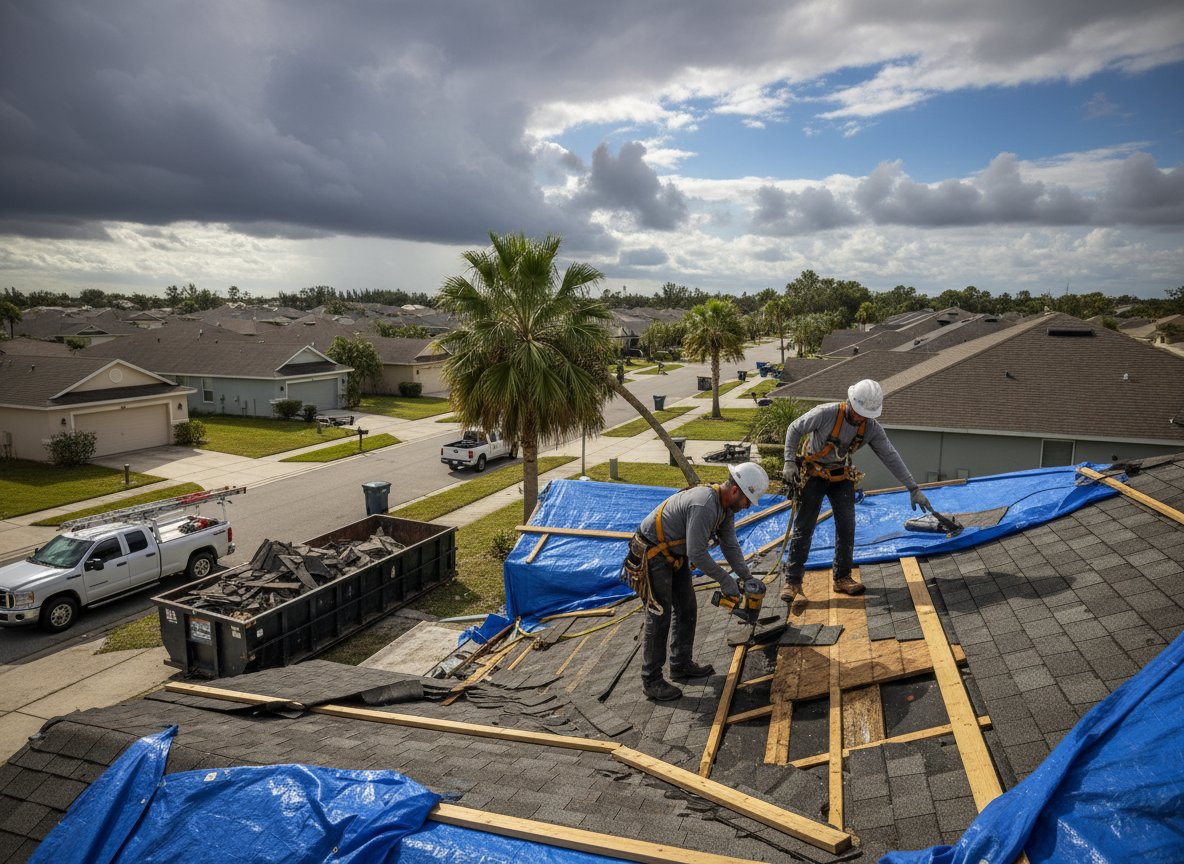
Clearwater is two roof markets stacked on top of each other. One is the beach: the barrier islands from Clearwater Beach through Sand Key, plus Island Estates on the sheltered side of the pass, where the buildings are low-rise houses, mid-century motels and a wall of condominium towers, and where every roof is judged by what salt spray and surge do to it. The other is the mainland: downtown around the harbor, the 1950s and 1960s blocks behind it, and the Countryside neighbourhoods to the east that were built out from the 1970s onward.
A roof on the beach and a roof in Countryside can be fifteen minutes apart and have nothing in common. One is fighting chloride and wind-driven rain off open water; the other is fighting heat, ponding on low-slope sections and the ordinary end-of-life of shingle and tile. Roof repair in Clearwater, FL means starting with which of those two conditions applies to the address, because the specification changes with it.
The Beach Side and the Mainland
On the islands, the roof stock is a mix of small 1940s and 1950s beach cottages that survived the redevelopment, 1960s and 1970s motel and apartment blocks, and high-rise condominiums from the 1970s through the 2000s. Island Estates is largely 1960s and 1970s construction on a residential island, with canals behind the houses and a roofscape of low-pitch shingle, flat sections over carports, and tile on the larger rebuilds.
Downtown and the streets behind the harbor hold Clearwater's oldest housing, including 1920s bungalows and Mediterranean Revival houses, mixed with 1950s block ranches and later infill. East of the city, Countryside and the neighbourhoods around it are the 1970s and 1980s subdivisions: concrete block and frame, hip roofs, concrete tile on a good share of them and shingle on the rest, with enclosed lanais and pool cages attached to many.
Clearwater is the Pinellas County seat, which means the downtown core has civic buildings, parking structures and commercial blocks whose roofs are membrane decks rather than pitched coverings. Those jobs are planned with a facility manager and a building engineer, and the survey reads drainage and equipment layout before it reads the surface.
Wind-Driven Rain, Salt and Surge
The prevailing summer storms arrive from the Gulf, and on a west-facing elevation that means rain driven at an angle rather than falling. Water pushed at that angle gets behind coverings, under flashings and into wall junctions, and the leak then appears at a ceiling line well inside the building with the covering apparently intact. On the beach this is the single most common reason a roof that looks fine is leaking.
Salt is the second condition, and it is relentless within a few hundred metres of open water. It does not dissolve shingle or tile. It corrodes the fasteners, the drip edge, the valley metal, the vent flues, the screws holding a metal panel, the clips on a tile roof. A beachfront roof can be structurally sound and still be a year from losing its edge in a gust, because the metal holding it has been quietly failing.
Hurricane Irma in 2017 stripped coverings and lifted edge metal across the city. Then came 2024. Helene passed offshore in late September and drove surge onto the Pinellas beaches, and Clearwater Beach took some of the worst of it: ground-floor units flooded, sand pushed into streets, buildings left with water in the walls. Milton followed in October, came ashore at Siesta Key and crossed the bay with wind that peeled roofs, moved tile and removed porch and lanai coverings across the mainland.
A building that took surge has a different problem from a building that lost shingles. Salt water in insulation and wall cavities keeps corroding metal and feeding damp long after the visible water is gone, and a roof repair on that building has to account for what is underneath it. That is why the survey on a beach property includes the attic and the ceiling structure, not just the surface.
The Coverings on Clearwater Roofs
Architectural shingle is the default across the mainland and on the older island houses. On a coastal site its weakness is not the mat but the details: the pipe boot, the ridge, the valley and every place where sealant was used instead of metal. Wind uplift at the perimeter is also higher here, so the edge detail and the fastening pattern carry more weight than they would inland.
Concrete tile covers a large part of Countryside and the later beach rebuilds. It is durable and it outlives the roof beneath it, so the membrane is what expires. On a tile roof of that generation, the underlayment is at or past the end of its service life, and the tile is still perfectly serviceable, which is why the repair is usually a lift-and-relay rather than a replacement of the covering.
Flat and low-slope assemblies appear on the carports, lanais and rear additions of the block houses, on the motel and apartment blocks, on the downtown commercial stock and on the towers. Built-up, modified bitumen and single-ply all occur, and the failure is nearly always at a seam, a drain, a scupper or a parapet rather than in the field.
Metal is the minority covering, more common on newer houses, on beachfront rebuilds designed for wind, and on commercial buildings. Standing seam with concealed fixings performs well near the water when the terminations are detailed properly; exposed-fastener panels fail at the washers, and near the salt they fail at the fasteners before the coating gives up.
Condominiums, Associations and Equipment on the Roof
A great deal of Clearwater's roof area belongs to associations rather than to individuals. On a condominium the roof is common property, the association is the client, and the work has to be planned around the building's operation: access, staging, the protection of units below, and the sequence in which sections are opened.
Tower and motel roofs also carry equipment that pitched roofs do not: condenser units on curbs, exhaust fans, skylights, satellite dishes, aerials, solar arrays and the mounting systems that hold them. Every one of those is a penetration, and every penetration is a place where the waterproofing has to be terminated correctly. On a membrane deck, a curb that was flashed with mastic and never maintained is a leak waiting for the first hard rain.
After a storm the association's question is usually about the whole envelope rather than one stain: what the wind did at the parapets and corners, whether the drainage still works, whether the equipment curbs are still watertight. That is a survey across the roof plan, and it produces a scope that can be prioritised rather than a single repair that leaves the next weak point untouched.
Where Water Gets In
The most common entry on a pitched roof here is a wall or chimney junction on the weather side, where wind-driven rain works at a flashing that was always marginal. The second is the valley, particularly where a hip roof meets a gable or where a lanai roof ties into the house.
On the flat sections it is the transition: the point where a low-slope carport or lanai roof meets the pitched main roof is a short, awkward detail, and it is where most of the leaks on the block houses begin. Behind that come the drain and scupper, then the parapet, then the seams.
On the beach, add the edge. A beachfront roof takes more uplift at the fascia and the rake than the same roof inland, and a lifted drip edge lets water behind the fascia and into the wall. That is a small repair that becomes a large one if it is left through a season.
The Work We Do Here
Leak repair is the bulk of it, traced from the ceiling back to the entry rather than patched at the stain. When a roof is open, emergency roof tarping holds the weather out until the repair can be scheduled, and emergency roof repair closes the openings that can be finished in one visit.
Storm and hurricane damage repair is the wider engagement, and on this coast it frequently involves separating wind damage from surge damage, because the two are treated differently by an insurer and repaired differently by a roofer. Roof repair or roof replacement is the next decision, and it follows the survey: a tile roof with a failed section on a sound deck is a repair, a shingle roof that has lost its mat across several planes is a replacement.
Roof installation covers the rebuilds and the new builds. The coverings are shingle roofing, tile roofing, metal roofing and flat roof repair, with roof coating for sound metal and membrane surfaces that need renewing rather than rebuilding, which is common on the low-slope sections behind the beach. Roof inspection is the service most owners here need first, because a coastal roof's remaining life is decided by its metal and its membrane, and neither is visible from the ground.
Permits and the Address Check
Clearwater is an incorporated city and permits its own roofing work through the city's building department. Addresses just outside the city line fall to unincorporated Pinellas County and its building and development review services, which runs a separate portal and a separate inspection schedule. On the islands the line is not always obvious, so the address is checked before the application is prepared.
Underneath either authority is the Florida Building Code, and on a coastal site the design wind speed and the product approval are the two facts that shape the specification. The covering has to be an approved product installed to its approval, with the fastening pattern that goes with it, and on a membrane roof the system and its attachment are named in the permit rather than selected on site.
Ten Miles Around Clearwater
Within about ten miles: Clearwater Beach, Sand Key, Island Estates, Belleair, Belleair Bluffs, Belleair Shore, Largo, Safety Harbor, Dunedin, Palm Harbor, Oldsmar, Indian Rocks Beach, Indian Shores and High Point. Each has its own jurisdiction or sits in unincorporated county territory.
Calling About a Clearwater Roof
What helps is the address, because it settles both the permit authority and how exposed the roof is. Then the covering, the age of the building, and where the water is showing. On a beach property, say whether the building took water during Helene, because that changes what the survey has to look at. Florida Roof Repair Pros, 4720 Millenia Blvd, Suite 175, Orlando, FL 32839, (407) 557-4529.
Around Clearwater
We regularly work near:
- 📍Clearwater Beach
- 📍Pier 60
- 📍Island Estates
- 📍Clearwater Marine Aquarium
- 📍Countryside
Roofing Company in Clearwater — Local Notes
- •City of Clearwater permits; Pinellas County for addresses outside the city line
- •Beach buildings need the attic surveyed after surge, not just the surface
- •Wind-driven rain finds wall and valley flashings before the field