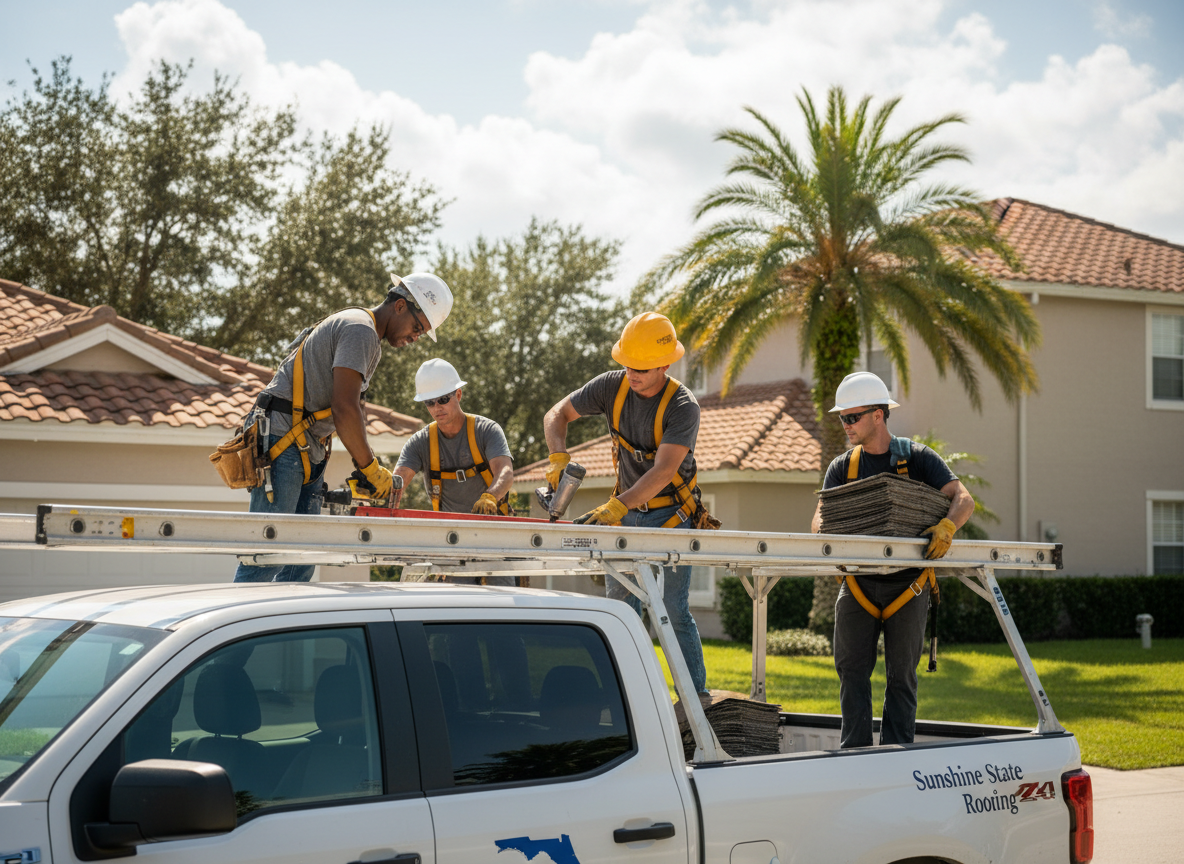
Brandon has no city hall. It is a census-designated place inside unincorporated Hillsborough County, which means every roofing permit for a Brandon address is issued by the county rather than by a municipal building department, and every inspection is scheduled through the county's system. That is not a technicality. It changes who reviews the application, how long the queue is and who signs off at the end, and it is the first thing to establish on any job here.
The other thing that defines Brandon roofs is the decade the street was built. The old centre around Brandon Boulevard has houses from the 1950s and 1960s. The big subdivisions that filled the space between Brandon and Valrico came in the 1970s and 1980s. The gated communities and the larger houses came in the 1990s and 2000s. Three generations of roof, three different assemblies, and a lot of them are now at the point where the covering and the details have both reached the end of their life at the same time.
Two Generations of Brandon Housing
The earliest stock is modest ranch housing: single-storey, concrete block or frame, hip and gable roofs at a shallow pitch, carports that were frequently enclosed later. These houses are small, which is good news for a roof repair, because the roof area is limited and a local failure can be fixed without touching the rest.
The 1970s and 1980s subdivisions are larger and more uniform: three-bedroom ranches and two-storey houses with architectural shingle, deeper roof planes and more complex hips, often with a rear lanai or a screened pool enclosure attached. By this generation the roofs have been through at least one covering's worth of Florida sun, and many have already been re-roofed once.
The 1990s and 2000s houses, particularly in the gated communities and around the golf courses, are bigger again, with concrete tile on a good share of them and complex rooflines: multiple hips, valleys, dormers, a covered entry and a lanai under the same roof. These roofs are now old enough that the details around the tile — valleys, boots, ridge ventilation, wall flashings — are the failing parts rather than the covering.
Shingle Country
Most of Brandon is shingle, and the honest description of a shingle roof here is that it is a good product in a hard climate. Heat drives the volatiles out of the asphalt, the daily expansion and contraction works at the seals, and the sun degrades anything exposed. A roof that would last thirty years in a milder climate does not get thirty years here.
What fails first is predictable. The pipe boots crack at around ten to fifteen years, long before the shingle field is finished, and a cracked boot is a direct path into the ceiling. Ridge caps lift and lose their seal at the gable ends. Valley metal rusts where debris holds moisture against it. Sealant at a wall, a chimney or a skylight hardens and separates, and the joint that was maintenance becomes a leak.
That is why so many Brandon leaks are small repairs that become expensive when they are left. A boot, a ridge cap and a valley are small areas of a large roof, and repairing them properly extends the life of the covering by years. Leaving them until the ceiling stains turns a small repair into insulation, drywall and a repaint.
Thunderstorms, Lightning and Wind
From June through September, Brandon gets the inland version of the Florida storm: build-up through the afternoon, then a short, violent downpour with wind, sometimes hail, and lightning that is the most underrated roof hazard in the state. A strike on a vent stack, a ridge vent or a metal flue can crack tile, split shingle and start a fire inside a wall without leaving obvious damage on the surface.
Wind is the second agent. The storms that cross the county in a straight line at fifty or sixty miles an hour do more cumulative damage across a suburb than a hurricane does, because they lift edges, peel ridge caps and drop limbs on dozens of roofs at once. Hurricane Irma in 2017 and Hurricane Milton in 2024 both reached Brandon, and Milton in particular peeled coverings and opened roofs across the eastern county with wind rather than surge, since there is no water here to flood.
There is also the tree load. Brandon's older streets have mature oaks and pines, and a limb on a shingle roof can puncture the deck without moving a single shingle out of line, which is why a leak with no visible damage from the ground is a normal finding here rather than a mystery.
The Leaks That Follow a Storm
After a wind event the calls run in a consistent order. First, shingle missing at a corner or a ridge. Second, water at a ceiling that appeared within hours of the storm. Third, a stain that grows over the following week as water that entered at the edge works its way through insulation.
The first two are usually connected. Wind gets under the edge of a shingle, lifts it, and breaks the seal; the next rain drives water sideways under the field and into the deck at a point well away from the lifted shingle. Repairing only the visibly lifted piece leaves the path open, which is why the survey follows the water rather than the damage.
On the older ranches, the enclosed carport is the other repeat offender. The flat section over it was often tied into the house wall with a short flashing and a sealant joint, and thirty years later both have failed. Water enters the wall, travels down a stud bay and appears at a ceiling or a baseboard inside.
Tile in the Gated Communities
Concrete tile is common in the 1990s and 2000s subdivisions, and it behaves differently from shingle in every respect. The tile itself is durable, fire-resistant and largely unaffected by sun; the underlayment beneath it is not, and the underlayment is the roof. On a tile roof of that age in Brandon, the membrane is at or near the end of its service life while the tile is perfectly sound.
The practical consequence is that a tile leak is not fixed by sealing the tile. It is fixed by lifting the tile at the affected area, replacing the underlayment, and relaying the original tile, with broken pieces replaced from matching stock. Where the failure is widespread, the whole field comes up, the membrane is replaced and the tile goes back down. Both are tile jobs and both are priced differently from a shingle re-roof, which is why the survey comes before the scope.
Ridge and hip details deserve particular attention on these roofs. The mortar or foam at a hip and ridge is exposed to the most sun and the most wind, and it is where a tile roof usually shows its age first.
How a Job Runs Without a City Hall
The survey comes first, on the roof and in the attic, with photographs of every junction, penetration and edge. On a two-storey house with a steep pitch that means access equipment rather than a ladder, and on a tile roof it means lifting tiles at the points that matter rather than walking the field.
The written scope names the materials, states what happens to the deck and describes how each junction will be rebuilt. The permit application goes to Hillsborough County's development services department through its online portal, with the product approval, the fastening schedule and the design wind speed for the site. On a tile roof the deck and underlayment are inspected while they are open; the final inspection follows completion.
Sign-off is a walk of the property with the owner, covering flashings, valleys, terminations, the lanai roof if there is one and the cleanup. The inspection record and the photographs are handed over at the end, because on a house that will be sold at some point, that file is worth keeping.
Where the house is in a deed-restricted community, there is a second approval to think about: the architectural review committee. A roof covering that matches the rest of the street is usually straightforward, but a change of colour or material is not, and it is worth checking before the material is ordered rather than after it is delivered. That review sits alongside the building permit and does not replace it.
Ten Miles Around Brandon
Within about ten miles: Valrico, Seffner, Mango, Limona, Dover, Bloomingdale, Lithia, Riverview, FishHawk, Apollo Beach, Temple Terrace and the eastern edge of Tampa. Every one of them is unincorporated Hillsborough County apart from Temple Terrace and Tampa, which have their own building departments.
Calling About a Brandon Roof
What helps is the age of the house, the covering, and where the water is appearing. If the roof has been re-covered rather than replaced, say so, because it changes what can be done on the deck. If the house is in a deed-restricted community, mention it, because the architectural review runs in parallel with the permit. Florida Roof Repair Pros, 4720 Millenia Blvd, Suite 175, Orlando, FL 32839, (407) 557-4529.
What an Insurer Asks For After Storm Damage
Brandon claims tend to be wind claims, and a wind claim is decided on evidence recorded before anything is taken apart. The useful record is straightforward: photographs of the damage from the ground and from the roof, the date and the weather event, the age of the covering if it is known, and a written description that separates what the storm did from what was already worn.
That last distinction is where most disputes begin. A shingle roof with fifteen years of sun on it has brittleness, granule loss and lifted seals before any storm arrives. A report that calls all of it storm damage is not credible, and a report that dismisses all of it is not useful either. What an adjuster can work with is a description of the fresh failures, the direction they run in, and whether they line up with the wind that came through.
On a tile roof the record is different again. Displaced and broken tile, cracked ridge mortar and lifted hip caps are visible from the ground, and the underlayment damage beneath them is not. Photographs taken while the tile is lifted are the only evidence that the water path exists at all, which is why they are taken during the survey rather than after the work has started.
Keeping the inspection record and the photographs together in one file, with the permit number, is worth the small effort. It is the same file that gets asked for at a sale, and it is the one that answers a letter from an insurer two years later.
Around Brandon
We regularly work near:
- 📍Brandon Town Center
- 📍Alafia River
- 📍Bloomingdale
- 📍Limona
- 📍Brandon Regional Library
Roofing Company in Brandon — Local Notes
- •Unincorporated Hillsborough County: permits go to the county, not a city
- •Shingle dominates; pipe boots and ridge caps fail long before the field
- •Deed restrictions may require architectural approval alongside the permit