Bonita Springs is two places with one name. There is the old town along the Tamiami Trail and the Imperial River, where the settlement began as a fishing and farming community and where the streets are short, the lots are small and the houses are older than the city itself. And there is the Bonita of the gated communities — Bonita Bay, Pelican Landing, Spanish Wells — built from the 1980s onward behind gates, on golf courses and mangrove edges, under tile. The city only incorporated in 1999, so almost everything standing here predates the government that now permits it.
The roofs reflect the two halves. Old-town houses carry shingle and the occasional metal roof over a simple gable, often patched and often enlarged. The gated communities carry concrete tile over a membrane installed in the 1990s or 2000s. Between them sit the condominium towers along Bonita Beach Road and the low-rise associations off US 41, each with a flat or low-slope roof shared by dozens of owners. Roof repair in Bonita Springs, FL, is therefore a different trade depending on which Bonita the address belongs to.
The River and the Bay
The Imperial River runs through the middle of the old town and reaches Estero Bay a few miles west, and the bay is the reason this coast is so low. Most of Bonita sits within a few feet of sea level, with a water table that rises and falls with the tide in the wet months. That has a direct consequence for roofs: drainage from the roof lands on ground that cannot always take it, and water that stands against a wall finds its way into stucco and into the wall base.
Estero Bay also shapes the wind. A house on the bay side takes an unobstructed load, and a house behind the mangroves takes less. The difference is visible in which roofs in a neighbourhood have lost ridge caps and which have not, and it is the reason two apparently similar houses a mile apart can need different specifications.
Old Town: Small Roofs, Long Histories
The oldest houses in Bonita are modest: single-storey, concrete block or wood frame, with a gable roof and a carport that was later enclosed. Most have been re-roofed at least twice, and many have had an addition put on at the back, which means the roof is now two roofs with a valley or a change of pitch between them.
On these houses the failure is at the joints. An addition meeting an original wall, a carport roof meeting the main plane, a porch roof tucked under an eave — those transitions were often flashed with what was available at the time, and thirty years later they are where water enters. The repair is carpentry and flashing work before it is a covering job, and a proposal that only quotes shingle is usually quoting the visible half.
The Gated Communities and Their Tile
The 1980s and 1990s communities were built with concrete tile, and the tile has held up well. What has not is the underlayment beneath it. A membrane installed in 1990 is now well past the age at which it stops shedding water, and the tile above it hides that fact completely from the street.
The first sign tends to be interior: a stain after a storm from a particular direction, a damp patch at a hip, or a musty smell in a room with a cathedral ceiling. Opening the roof at a valley and at a hip junction establishes the condition. On these roofs the tile is usually worth keeping, and the work is a lift-and-relay over new membrane rather than a replacement. The complication is association approval: in a gated community the covering, the colour and sometimes the contractor are all subject to the association before they are subject to the city.
Condominiums and Shared Roofs
A large part of Bonita's housing is attached: low-rise associations, villas and mid-rise condominiums, many with flat or low-slope roofs over several units. Those roofs fail differently. There is no attic to read and no single owner to make the decision, so the work is usually driven by a board, a reserve study and a maintenance schedule.
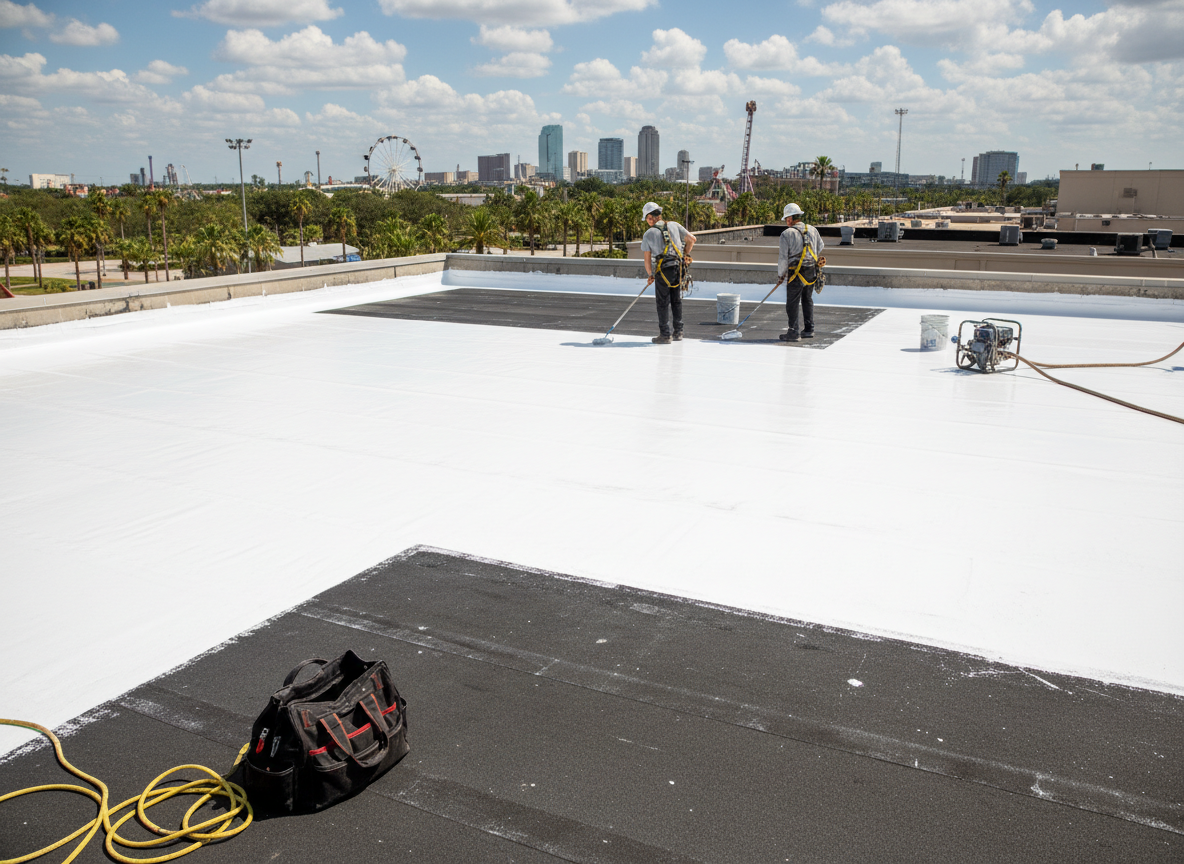
On a flat roof the failure is at the seams, the drains and the parapet walls. Ponding is the diagnostic question: where water stands after rain, the membrane is being asked to do something it was not designed for, and patching only moves the problem. Coating can extend a sound roof that has useful life left, and it cannot rescue one that has lost its fall.
Charley, Irma and Ian
Charley crossed Charlotte County in August 2004 and brought wind across northern Lee. Irma crossed the peninsula in September 2017 and put water into low ground across the county. Ian came ashore at Cayo Costa in September 2022 and pushed surge into Estero Bay and up the Imperial River, which is the event most local roofs are now dated against.
Surge is the local risk rather than wind alone. On the bay side and along the river, water reached houses that had never been wet, and a roof over a flooded house is a roof over a wet assembly. Decking, insulation and ceiling board all hold moisture, and a covering that looks intact can sit over a structure that needs to dry and be assessed. That is why the visit after a flood event is a moisture survey before it is a roofing survey.
What the Salt Does on the West Side
West of US 41, the salt load rises with every street toward the beach. It attacks the metal rather than the covering: drip edge, valley metal, hip and ridge flashings, vent collars, the fixings on a metal panel, the frames of lanai enclosures. On the beach side of Bonita Beach Road these are the parts that fail first, and they fail under a field that still looks sound.
The practical answer is a specification built around fastenings and compatible metals. Stainless or coated fasteners, no aluminium in contact with copper where water runs, and flashings replaced rather than reused where they have already corroded. On a house within a few streets of the bay that is the part of the job that decides how long the roof lasts.
Where a Bonita Roof Leaks
The entry points are consistent: a valley where two planes meet, a hip on a tile roof, a wall junction where stucco has cracked, a plumbing boot, a skylight curb, and the join between a pitched roof and a flat lanai. On the older houses add an addition joint and a carport transition. On the condominiums add a parapet, a drain collar and a seam.
Water travels before it shows. On a single-storey house it may run along a truss for ten feet; in a two-storey villa it may appear at a first-floor wall. The survey therefore photographs the junctions and the penetrations, and the repair is priced from what is found there rather than from the stain.
The Services Available Here
The list is the site's own, applied to this stock. Roof leak repair is the diagnostic core. Emergency roof repair and emergency roof tarping cover the night a storm opens the roof and water is running into a room. Storm and hurricane damage repair handles the documented sequence after an event: make safe, photograph, repair, and keep a file an insurer or a board can follow.
Roof repair is the everyday work, and here it is often flashing and carpentry at additions and transitions. Roof replacement and roof installation handle the end of a layered shingle roof or a tile roof whose membrane has gone. Shingle roofing covers the old town and the 1970s streets. Tile roofing covers the gated communities, mostly as underlayment replacement beneath tile that is kept. Metal roofing suits the bay-front houses. Flat roof repair and roof coating cover the condominium roofs, the lanais and the small commercial buildings along US 41. Roof inspection is the visit that starts all of it, and for a board or a buyer it is the document that matters.
How a Bonita Job Runs
The first visit is a survey: ladder, roof where it can be walked, attic where there is one, camera at every junction. On a tile roof the field is opened at a valley and a hip so the membrane can be seen rather than assumed. On a condominium the survey also records the drains and the parapet.
Then the written scope, which separates replacement from repair, names the underlayment and fastening method, records what is assumed about the deck, and lists exclusions. In a gated community the scope goes to the association as well as the city, because the covering and colour may be controlled before the permit is even filed.
The permit is filed before work starts, and inspections are booked to the jurisdiction's stages. The close-out is a walk with the owner or the board covering edges, terminations, drains and cleanup, plus photographs of everything now covered up. On a shared roof that file is the record the next reserve study will be built on.
Permits in Bonita
Addresses inside the City of Bonita Springs are permitted by the city's building department. Unincorporated addresses that use a Bonita Springs mailing address go to Lee County. Estero, immediately north, is its own village with its own permitting service, and Naples to the south is in Collier County. The boundary is checked against the address before a date is offered.
The Florida Building Code applies beneath the local permit. Lee County is outside the High-Velocity Hurricane Zone, which covers Broward and Miami-Dade, so the zone's extra underlayment chapter does not reach here. The wind provisions do, and the coastal part of the county is in the wind-borne debris region, which brings product approval and opening protection into a replacement permit near the water.
Within Ten Miles
Estero and San Carlos Park to the north, Bonita Beach and Little Hickory Island to the west, Spanish Wells and Pelican Landing along the bay, Three Oaks and Miromar Lakes inland, and Naples Park and Vanderbilt Beach across the Collier line. Each has its own permit desk or none, and the exposure changes street by street as you move toward the water.
Calling About a Bonita Springs Roof
The address settles the permit desk and, in a gated community, the association. The covering settles the survey method, because a tile roof is opened and a shingle roof is walked. The age of the roof, or the date of the last permit, decides whether this is a repair or a replacement discussion. The office is at 4720 Millenia Blvd, Suite 175, Orlando, FL 32839, and Bonita Springs calls come to (407) 557-4529.
Around Bonita Springs
We regularly work near:
- 📍Barefoot Beach Preserve
- 📍Imperial River
- 📍Estero Bay Preserve State Park
- 📍Bonita Beach
- 📍Riverside Park
Roofing Company in Bonita Springs — Local Notes
- •City of Bonita Springs permits its own addresses
- •Gated community and condo association approval usually precedes the city permit
- •Estero Bay surge in 2022 reached streets that had never flooded