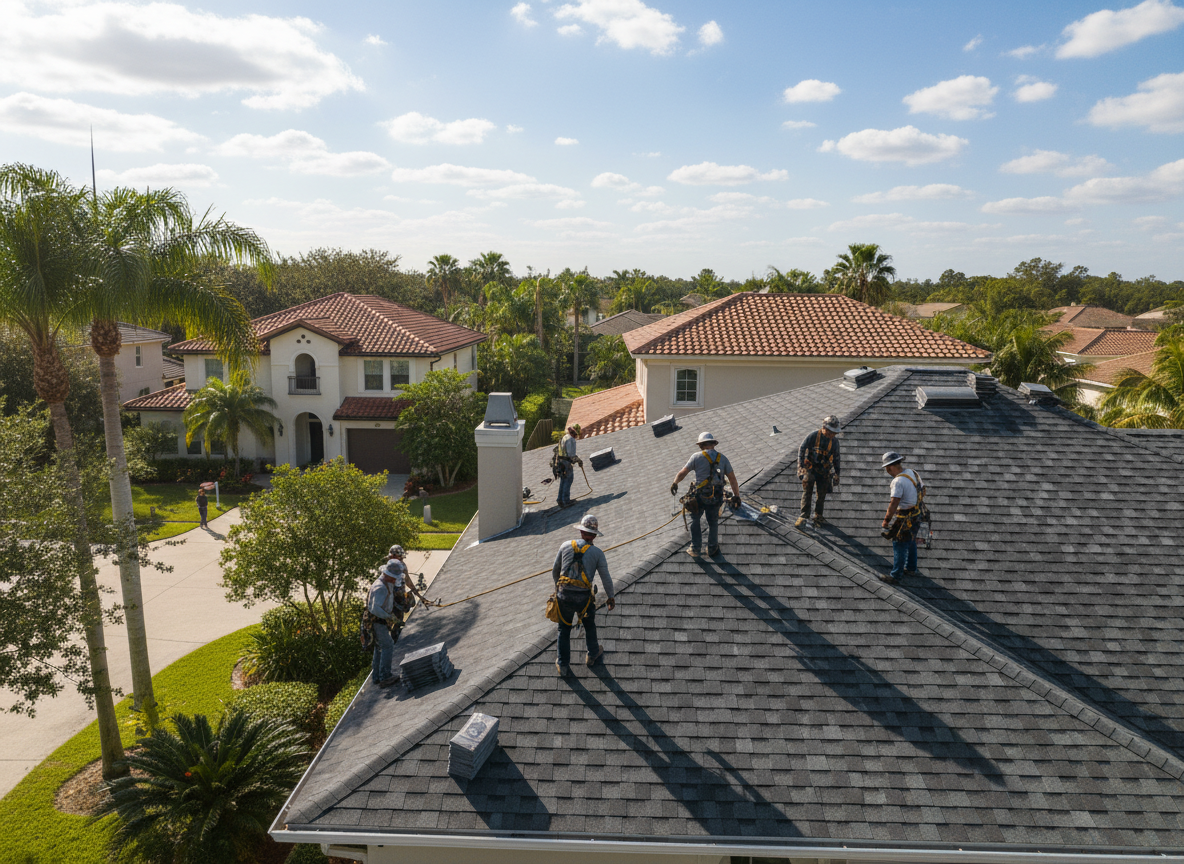
Boca Raton is the only city in this group that sits outside the High-Velocity Hurricane Zone, and that single fact changes how a roof here is specified. The zone takes in Broward and Miami-Dade; Palm Beach County lies north of it, so the extra chapter of the Florida Building Code that governs underlayment systems and product approval in Fort Lauderdale does not apply here. The wind provisions of the code still do, exactly as they do everywhere in the state, and the ocean and the Intracoastal are close enough that nobody should mistake the difference for shelter. Roof repair in Boca Raton, FL is a matter of reading two very different roof stocks and then satisfying whichever authority owns the address.
Those two stocks are separated by about fifty years and a few miles of highway. East of the Intracoastal, the city is the 1920s resort that Addison Mizner designed, still dominated by Mediterranean Revival buildings under clay barrel tile, with historic districts that review how a roof looks as well as how it is built. West of the turnpike, the city is gated development from the 1980s onward: larger footprints, more complex geometry, concrete tile and shingle. Florida Roof Repair Pros covers Boca Raton from an office in Orlando, and the number for this city is (407) 557-4529.
The Eastern City and Its Clay
Through the historic core the roof stock dates from the 1920s and 1930s and is overwhelmingly clay barrel tile over a masonry deck. That tile is the reason the city looks the way it does, and it is also the reason so many of these roofs are misjudged. The tile is not the waterproof layer. It sheds the bulk of the rain and takes the sun, but the barrier is the membrane underneath, and on a roof approaching a century old that membrane has been replaced at least once and may be due again while the original tile remains entirely serviceable.
Two consequences follow. The first is that a leak here is usually a membrane question, not a tile question, and the answer is often to lift the field, replace the failed section of underlayment and relay the same tile. The second is that the roof is visible in a way a suburban roof is not. Altering its appearance in a historic district is not the same as re-roofing a house in a subdivision, and the approval process can extend to the profile of the tile and the colour of the finished roof. That is worth establishing before material is ordered, not after.
The Western City and Its Geometry
West of the turnpike the city belongs to the 1980s and 1990s: gated communities and country-club subdivisions with larger footprints and steeper, more complicated roofs. Concrete tile in barrel, S-profile and flat profiles covers a large share of it, architectural shingle covers other streets, and metal appears on a minority of newer and renovated houses. The geometry is more intricate than it looks from the road — multiple planes, hips and valleys, dormers, and a great deal of ancillary metal at the transitions.
The age of that stock is now the issue. A roof installed in the late 1980s or early 1990s has reached the point where the underlayment beneath a tile field is at or past the end of its service life, even where the tile is intact and the roof has never leaked. That is the awkward middle of a tile roof's life: nothing looks wrong, the membrane is quietly finished, and the first indication is a stain after a wind-driven storm. A survey is the only way to know, and on a house of that age it is worth knowing before a rainy season rather than after one.
Outside the Zone, Still Under the Weather
Because Palm Beach County is outside the hurricane zone, a Boca Raton specification is not written the way a Broward one is. Inside the zone the code adds its own chapter with specific underlayment methods, product approval requirements and attachment rules; here the wind provisions of the Florida Building Code govern without that additional layer. On some roofs that widens the range of products available and changes the specification.
None of which makes this a mild environment. The city fronts the ocean and the Intracoastal, so salt sits on every surface east of the highway and rides inland on the wind. Sun is relentless. Summer storms arrive with the same intensity as anywhere in South Florida. And the hurricane record is direct: Wilma crossed the peninsula from the Gulf side in October 2005 and affected Palm Beach County along with Broward, while in 2004 Frances and Jeanne came ashore at Hutchinson Island to the north and lashed this stretch of coast. Roofs here are tested, and the ones that fail are the ones with a weak edge or an aged membrane.
Where Boca Raton Roofs Fail
On tile roofs the answer is almost always the underlayment, and the tell is where the water appears. A leak that shows up after wind-driven rain rather than after a straight downpour usually means water is getting under the tile and finding a way through a membrane that has aged out. Because water travels along the deck and the battens, the stain inside is often well away from the damaged area, and the tile above it may be entirely sound.
On shingle roofs the order is pipe boots, ridge caps, valleys, then the transition to any flat or low-slope section — a porch, a cabana, an addition. On the flat sections it is the perimeter and the drainage: a parapet flashing that has separated, a scupper that has silted, a seam that has opened at the low point. And on every roof type here, the edge and the wall junctions are where wind and salt do their work, both of them out of sight from the ground.
What the Two Authorities Ask For
A Boca Raton roof can need two approvals rather than one, and they ask different questions. The building department asks whether the assembly is code-compliant for the site: design wind speed, product approval for the covering, fastening schedule, underlayment specification. A historic district approval, where the property sits inside one, asks what the roof will look like when it is finished, which can reach the tile profile, the colour and the visibility of any change from the street.
Getting the order right matters. A building permit issued for a roof that the appearance approval then refuses is a job that has to stop halfway, and on a tile roof the material may already be on site. Establishing both before ordering is the difference between a job that runs to schedule and one that stalls.
The Work Itself
Every service on this site is available in Boca Raton, and the survey decides which applies. Leak repair is the most common call, and on a tile roof it begins with lifting the field to inspect the membrane rather than sealing the surface. Tarping and emergency repair cover the sudden openings after a storm. Storm and hurricane damage repair is the wider job, and it starts with documenting what the wind did across the whole roof, separated from what was already worn.
Inspection is frequently the only service required — on a purchase, a sale, an insurer's request, or simply to establish where a 1990s tile roof actually stands. Replacement and installation cover the cases where the membrane or the shingle field has gone across the entire roof. The coverings are tile for the core and the western subdivisions, shingle for a share of the later streets, metal on a minority of properties, and flat repair with coating on the low-slope sections and the commercial stock.
One point is worth stating plainly: on a tile roof the decision is not tile or no tile. Where the tile is sound, the work is often a re-roof of the membrane with the original tile relayed, which preserves the appearance the historic district exists to protect and costs less than new tile.
How a Job Is Sequenced Here
The survey opens it: a walk of every accessible plane, the deck inspected from below, photographs of valleys, hips, penetrations, edges and wall junctions, and a check of any low-slope section and its drainage. On a historic-district property the survey also records the tile profile and the existing finish, because the approval process will ask about both.
The written scope follows. It states what is being replaced, what is being repaired, which materials and underlayment are specified, what the work assumes about the deck, and what is excluded. Where a permit is required, that scope is the basis of the application. On a tile roof the sequence usually includes an inspection of the underlayment before the field is relayed, which is the moment the membrane is actually visible and worth photographing.
The work then follows that sequence, and the finish is a file rather than a handshake. The completed inspection record, photographs of everything now hidden beneath the tile or the shingle, and a walk of the property with the owner covering flashings, valleys, penetrations and cleanup. On a historic property that file is also the evidence that the finished roof matches what was approved.
Permits in Palm Beach County
Property inside the City of Boca Raton is permitted by the city's building department. Palm Beach County handles unincorporated addresses, and the other municipalities in the county handle their own. Because the city sits outside the hurricane zone, the permit questions turn on the Florida Building Code's wind provisions rather than the zone chapter — but the design wind speed for the site, the product approval for the covering, the fastening schedule and the underlayment specification are still the substance of the application.
On a property inside a historic district there is a second layer of approval, and it concerns appearance rather than structure. Both are established before material is ordered.
Within Ten Miles
The city's neighbours are close. Highland Beach is immediately north, Deerfield Beach and Hillsboro Beach lie south across the county line, Delray Beach is about nine miles up the coast, and Parkland, Coconut Creek and Lighthouse Point sit inland and to the south within the same radius. Each has its own building department and its own roof stock, and work there is planned the way it is here.
The Two Questions Buyers Ask
The first question on a Boca Raton purchase is how old the underlayment is, not how old the tile is. On a 1990s house in the west, or a 1970s re-roof in the historic core, the membrane is the component with a finite life, and the tile above it may be good for decades more. A survey that lifts a section at a valley and at a hip junction answers it; an inspection that stays on the ground cannot.
The second is whether the tile can be matched. On an older roof a small repair may need tile from a profile that is no longer made, and the practical answer is often to reuse what is already there by lifting and relaying it rather than replacing the field. That is why the survey records the profile and counts the spare material before a repair is scoped.
Before You Call
Have the address ready, because it decides the building department, and say whether the house is east of the Intracoastal, because that usually settles whether the roof is clay tile or something later. A photograph from the ground helps before the first visit, and the date of the last roof permit is worth finding. Florida Roof Repair Pros works from 4720 Millenia Blvd, Suite 175, Orlando, FL 32839, and Boca Raton calls reach (407) 557-4529.
Around Boca Raton
We regularly work near:
- 📍Boca Raton Resort and Club
- 📍Mizner Park
- 📍Red Reef Park
- 📍Gumbo Limbo Nature Center
- 📍Spanish River Park
Roofing Company in Boca Raton — Local Notes
- •City of Boca Raton permits its own addresses
- •Palm Beach County is outside the High-Velocity Hurricane Zone
- •Clay barrel tile over underlayment; tile is not the barrier